A school photography fundraiser works when the school sets a fair price, collects the money through its own payment portal, and delivers each family only their own child's photos. Choose one of four models: a commission share from a hired photographer, a flat package price, pay what you can, or sponsor-funded free photos. Then check that the number of families likely to buy covers the photographer's fee before you promise anything.
Sports day costs money to run. There are ribbons, water, first aid cover and, often, a photographer whose fee leaves the budget and never comes back. Parents want those photos anyway. This guide is for athletic directors, PTA and booster club volunteers, and the photographers they hire. It covers the real costs, the four models, a worked example, payment, consent, and how to tell parents.
What does a sports day photographer actually cost?
Start with the full cost, not only the day rate. A quote usually covers the shooting time. A fundraiser adds smaller lines that are easy to forget until the bills arrive.
- The photographer's fee. A day rate, a half-day rate, or nothing upfront if they work on commission.
- Editing. Selecting and correcting a few thousand frames can take longer than the event itself. Ask whether it is included.
- Delivery. Whatever your gallery or delivery platform charges to process and share the photos.
- Payment fees. Your school portal or card processor usually keeps a small fee on every sale.
- Printing. Letters home, flyers and QR codes on the programme.
- Prints, if you offer them. Lab costs and postage for each order.
Volunteer time is a cost too. Someone has to answer parent emails, match payments to children and chase late orders. If nobody has those hours, choose a model where the photographer handles the selling.
Which school photography fundraiser model fits your school?
There are four common models. The main difference is who carries the risk if parents do not buy.
Commission share from a hired photographer
The photographer shoots for free or a small fee, sells directly to parents at their own prices, and pays the school a share. The UK parent-teacher network PTA+ describes this in its guide to working with photographers as making commission on the photographer's photo sales after the event. The school carries no financial risk, but it earns less per family and does not control the price. Put the percentage, the price list, the sales window and the payout date in writing.
If you are the photographer in this deal, the choice of sales platform matters more than the camera. Our comparison of sports photo sales software covers what to look for.
Flat package price
The school pays the photographer a fixed fee, then sells one package to families: for example, every full-resolution photo of their child for one price. The school keeps everything above its costs. This model earns the most when many families buy, and it loses money when few do.
Pay what you can
Families choose their own amount, usually with a suggested figure. It feels fair and builds goodwill, but income is harder to predict. In the United States, when the school or booster club is a charity and a family pays more than $75 while receiving photos in return, the IRS rules on quid pro quo contributions require a written statement with a good faith estimate of what the photos were worth. Outside the US, check your local charity rules.
Sponsor-funded free photos
A local business pays the photographer's fee, and every family gets their photos free. The sponsor is thanked in the programme and on a banner at the track. In an NFHS (National Federation of State High School Associations) article, one athletic director notes that local businesses may give larger amounts when they can see their logo at the venue. This model raises no photo income directly. It removes a cost from the budget and gives every child their photos, and you can still add an optional donation link to the delivery message.
A worked example: when does the flat model break even?
The numbers below are hypothetical. They show the method, not a result you should expect. Put your own quotes and your own school size into the same steps.
Picture a primary school with 600 pupils. It hires a photographer for a flat $600, sells one package per child at $15 for all full-resolution photos of that child, and expects about 3,000 finished photos.
- Photographer: $600.
- Delivery: processing 3,000 photos on Lenzeit's free Freemium plan uses 3,000 credits at $0.02 each, so $60. Other platforms price differently, and the Lenzeit pricing page lists the paid plan rates.
- Printing letters and QR flyers: $30.
- Payment fees: assume 3% per sale for this example, about $0.45 on each $15 package.
Fixed costs come to $690. Each sale brings in $14.55 after fees. The school breaks even at 48 packages, which is 8% of families. If one family in four buys, that is 150 packages, $2,182.50 after fees, and $1,492.50 profit.
Now run the commission version of the same day. The photographer charges nothing upfront and sells packages at $25. If the same 150 families buy and the agreed share is 20%, the school receives $750 and pays nothing. Less money, but no risk.
Know your break-even number before you sign
If you cannot picture 48 families paying, the flat model is a gamble. Ask the photographer for a commission deal, or find a sponsor to cover the fee.
How do you offer free previews and paid full-resolution downloads?
A tiered offer lets every family see their child's photos before paying. The free tier is small web-size previews. The paid tier is the full-resolution files, and prints if you want to offer them. Web-size files are too small to print well, which protects the paid tier on its own. If you also want a watermark on previews, add it when you export from your editing software, because Lenzeit does not add watermarks.
The simplest way to run two tiers is two separate deliveries from the same edit. In Lenzeit, put the web-size set in one secure, invite-only event for every family with photo permission. Put the full-resolution set in a second secure event and register only the families who have paid. Each family receives an access code by email and opens only the photos their own child appears in, with no app and no account. Nobody browses the whole school. The guide to how families receive their photos shows the parent side.
If you add prints, keep them as a separate order line. Print fulfilment works much the same at a school as at a festival, and our guide to print-on-demand for event photos covers the options.
How do you keep the price fair for families?
Parents compare your price with what they could shoot on their own phones, and with what the money will buy. These habits stop a sale from feeling like a tax on proud parents:
- ✓Price per family, not per child, or give a sibling discount, so a family with three children does not pay three times.
- ✓Give every child one free photo, such as a single web-size image, so no family is left out.
- ✓Offer a quiet hardship route, such as a pay-what-you-can option or a code from the school office that nobody else sees.
- ✓Say exactly where the money goes. "Every package helps buy new hurdles for the athletics club" is more convincing than "support the school".
- ✓Set one clear deadline. A single sales window is easier to understand than early and late prices.
How do parents pay through the school's own payment portal?
Most schools already collect money online: a payment portal for trips and lunches, an online shop, or a booster club's payment link. Use it. Parents already trust it, the money lands in the right account, and the office already knows how to issue receipts and refunds.
Lenzeit does not take payments today. Selling photos through Lenzeit is a Pro and Premium feature marked as coming soon, so for now the checkout stays on the school's system and Lenzeit handles the event photo delivery.
- Create one product in the portal, such as "Sports day photo package", with the price, the deadline and one line on where the money goes.
- Collect only what you need at checkout: the child's name, class and the parent email that should receive the photos.
- Close sales on the stated date, then export the list of paid orders.
- Match each order to a child, and register those families for the full-resolution delivery.
- Send access within the time you promised, and contact any family whose order you could not match.
Under the commission model, the photographer takes payment on their own store instead. The school's job is to agree the sales report and the payout date in writing.
Consent and safeguarding come before any sale
Selling photos of children only works if the school already has permission to take them and a clear route for families who say no.
In the United States, FERPA (the Family Educational Rights and Privacy Act) lists a student's photograph as one type of directory information. Schools must give public notice and let parents refuse that designation. In the UK, the Information Commissioner's Office says pupils or parents must be informed how photos will be used, and recommends letting pupils opt out. The NSPCC's guidance on photographing children advises against supplying children's names with their images. This is general information, not legal advice. Follow your school or district photo policy, and check with your counsel.
For a fundraiser, that means three things. Say in the permission letter that photos will be sold to families to raise money. Never publish a public gallery of children, and deliver family by family instead. And give the photographer the opt-out list before the day, not after. Our guide to school photo opt-out covers how to handle those students without slowing the event, and sharing school event photos with parents safely covers consent forms in more depth.
On a Pro or Premium plan, FaceLock™ lets you lock an opted-out child's face so photos containing that face are never delivered to anyone. A group shot that includes the child is held back rather than blurred, so check your team photos before sales open.
How do you market the photos to parents before sports day?
Parents buy when they hear about it before the day and when buying takes one step. A simple timeline:
- Three weeks before: a letter or email home with the price, what is included, where the money goes, and how to opt out.
- One week before: a short post in the class app or school messaging channel repeating the price and the deadline.
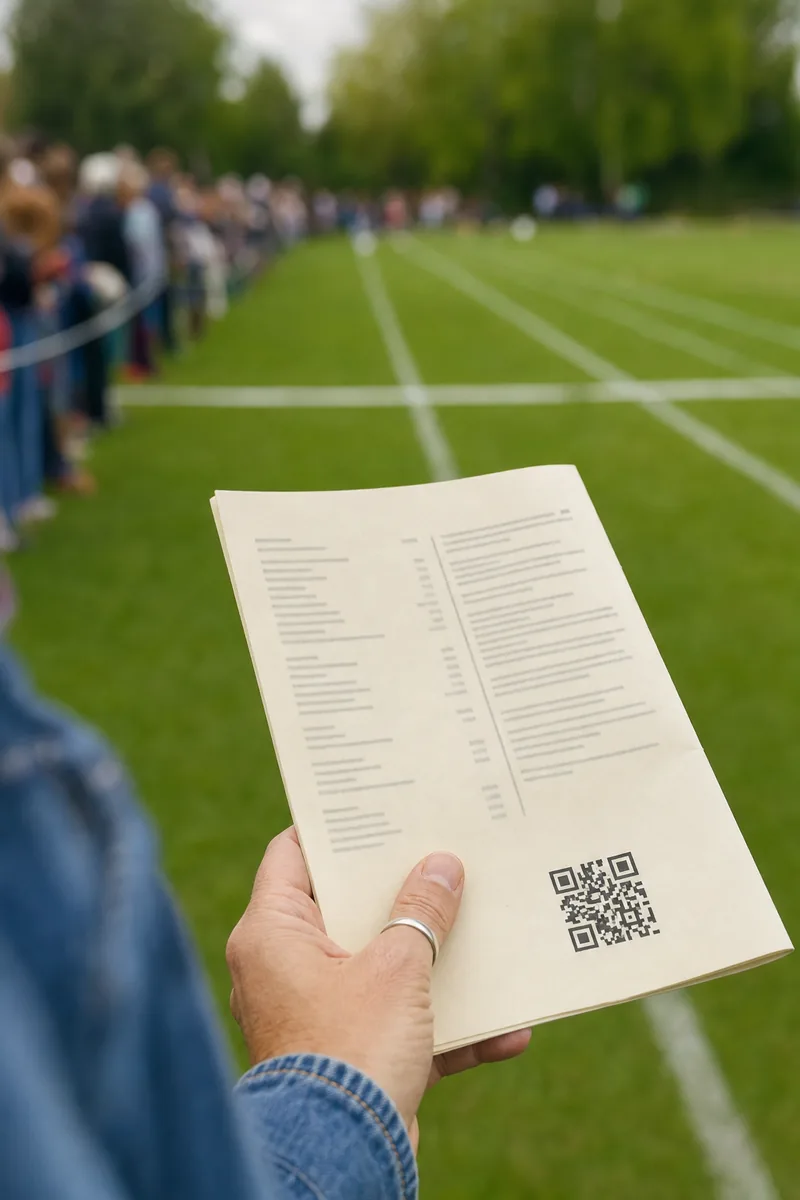
- On the day: a QR code on the sports day programme and on a sign near the finish line, linking to the school's payment page.
- At the end of the day: a message saying when previews will arrive.
Keep every message short and identical in its facts. Parents read school messages on their phones between other things, so the price, the deadline and the link should fit on one screen. A photo of last year's event, with no identifiable children, does more than a paragraph of persuasion.
What should you do after sports day?
Most of the money arrives after the event, so the follow-up matters as much as the photography. Send the preview links while the day is still fresh, ideally within a few days. Send one reminder shortly before the sales deadline, and none after it.
When sales close, tell families what was raised and what it paid for. NFHS advice for athletic directors includes sharing booster club budgets at the start, middle and end of the school year, and the same openness makes next year's photo sale easier. Ask one question in that message: what would make them buy next time.
Keep the finished photos organised by event. The same set can feed the yearbook later, and the digital yearbook guide shows how to build one from a year of event photos.
A school photography fundraiser is a small business for one afternoon. Know your costs, pick the model that matches your appetite for risk, take payment on the system your school already trusts, and make sure every family sees only their own child.