
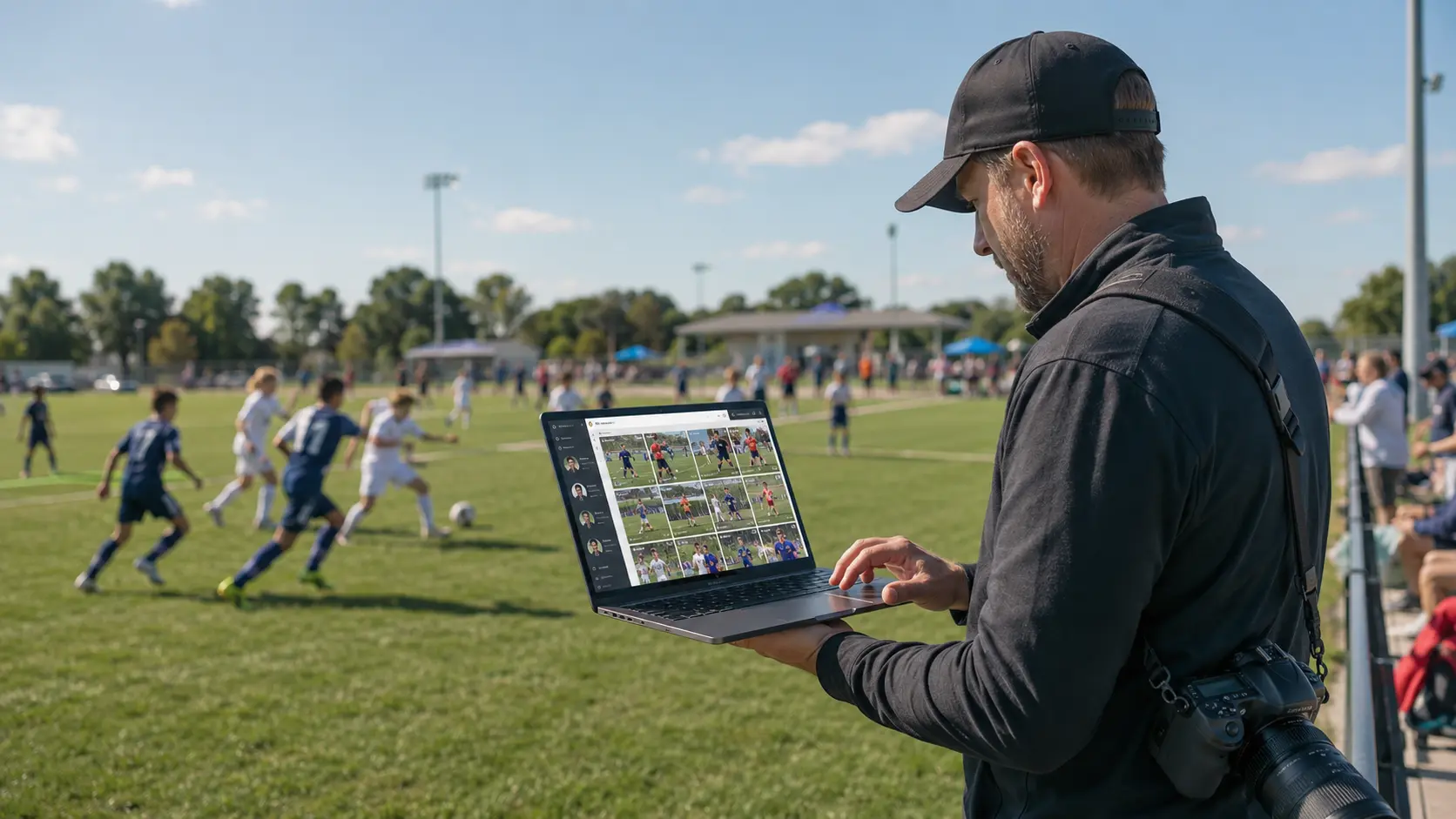
The best sports photo sales software for youth sports photographers combines fast bulk processing, athlete-level photo discovery, mobile galleries, protected previews, flexible selling options and privacy controls. The goal is simple: help each parent or player find the right photos quickly enough to view, download or purchase them without asking the photographer to search manually.
A normal client gallery can display photographs beautifully. A purpose-built sports photography sales platform must do more. It has to handle thousands of action images, identify the same athlete across a full game or tournament, reduce gallery scrolling, work well on a phone and keep the photographer's delivery workflow manageable.
What Is Sports Photo Sales Software?
Sports photo sales software is a platform photographers use to upload, organize, protect, deliver and sell photographs from games, races, leagues and tournaments. The strongest platforms connect the photographer's high-volume workflow with a simple customer journey: open the event, find the athlete, preview the photos, choose a package and receive the permitted files.
- For the photographer: bulk upload, automated sorting, gallery controls, watermarking, pricing and delivery.
- For the parent or athlete: fast search, a mobile-friendly gallery, clear purchasing choices and simple downloads.
- For the league or organizer: a professional photo experience that can be shared through a QR code, email, registration page or team communication channel.
Why Youth Sports Photographers Need More Than a Standard Gallery
Youth sports creates a discovery problem before it creates a sales problem. A photographer may capture several teams, age groups and fields in one day. Parents rarely want to browse every photograph from the event; they want the images containing their child.
- Large galleries create friction. A parent may abandon the gallery before reaching the relevant match or player.
- Manual athlete folders do not scale. One tournament can require hundreds of folders, repeated copying and hours of administrative work.
- Jersey numbers are not always visible. Players turn away, uniforms fold, arms block numbers and several teammates may wear similar equipment.
- Interest falls after the event. The strongest delivery window is while families are still talking about the game and looking for highlights.
- Open galleries may be inappropriate. Youth events require deliberate access, consent and safeguarding decisions rather than one public folder for every family.
This is why the search for the best software for youth sports photographers should begin with workflow and customer discoverynot gallery appearance alone.
9 Features the Best Sports Photo Sales Software Should Have
1. High-Volume Upload and Processing
Sports events generate more files than a typical portrait session. The platform should accept large batches, keep events organized and process new uploads without forcing the photographer to rebuild the gallery each time. For multi-field tournaments, the ability to publish additional batches during the day is especially useful.
2. AI Face Search or Athlete Identification
Photo discovery is the core feature. AI face search allows a consenting athlete or parent to use an approved reference image to find matching photographs across the event. For races, bib-number search can also be useful. For field and court sports, face-based discovery helps when numbers are hidden, duplicated across teams or absent from warm-up and celebration photographs.
Lenzeit's MagicSort™ groups event photographs by the people detected in them, helping photographers move from one large gallery to person-wise discovery without manually tagging every frame.
3. Personalized Athlete Galleries
Search should lead to a focused gallery containing the relevant player's action shots, portraits, team moments and celebrations. This is more useful than dropping the customer into the complete event collection and asking them to keep scrolling.
4. Mobile-First Access With No App Required
Most parents will open the gallery from a phone at the venue, in the car park or through a team message. The buying journey should therefore work in a mobile browser without requiring a separate app installation. A QR code can connect printed signs, photographer cards or league communications directly to the event gallery.
5. Same-Day or Live Photo Delivery
Fast delivery turns photography into part of the event experience. Look for software that allows the photographer to upload edited JPEG batches during the game or tournament and publish them without waiting for the entire event to finish. Lenzeit's live workflow is designed to make newly uploaded photographs discoverable while the event is still active.
6. Watermarked Previews, Paywalls and Packages
A sports photography sales platform should let customers evaluate an image without giving away the full-resolution file. Useful controls include watermarked or blurred previews, paid originals, individual downloads and multi-image bundles such as a full-game or full-tournament pack.
The package structure should match the assignment. A tournament photographer may sell individual action photographs and a complete athlete bundle, while a league working on a prepaid contract may offer downloads as part of the registration or photography fee.
7. Privacy Controls for Youth Sports
Youth sports software should offer more than a hidden URL. Photographers need control over who can open an event, how a person finds photographs, which images are visible and when the gallery expires. Public, private and invite-only delivery modes allow the access model to match the event.
Lenzeit's FaceLock™ adds face-level controls for situations where selected people should not appear in another visitor's results. The photographer should still review the gallery configuration, event permissions and local requirements before publishing.
Youth sports privacy requires a real policy
Photography, facial recognition and sales involving minors may be governed by venue rules, school or league policies, consent requirements and privacy or biometric laws. Obtain qualified legal guidance for the event location, provide clear notice, create an opt-out or removal process where appropriate, and never describe a software setting as a substitute for lawful authorization.
8. Pricing That Matches a Seasonal Business
Youth sports photography can be seasonal and event-driven. Compare monthly subscriptions, storage limits, transaction fees, commissions and per-photo processing costs against the number of events you actually cover. A low monthly price can become expensive during the off-season, while a commission-based platform may cost more as sales grow.
Lenzeit uses pay-as-you-go processing: one credit processes one photo, new accounts receive free starter credits and purchased credits do not expire. Review the current Lenzeit pricing before estimating a tournament.
9. A Workflow That Fits Your Existing Editing and Business Tools
Sports photo sales software does not have to replace Lightroom, Capture One, Photo Mechanic, your accounting system or a full studio CRM. The best setup may use one tool for editing, another for contracts and invoices, and Lenzeit as the AI sorting, discovery and delivery layer.
What Is the Best Software for Youth Sports Photographers?
The best choice depends on how you earn money and where your current workflow breaks. A photographer selling action photos after a tournament needs rapid discovery and protected online sales. A studio running scheduled team-and-individual picture days may prioritize rosters, prepay orders, lab fulfillment and composite products. A race photographer may need both bib and face search. A school or academy may prioritize controlled parent access above public browsing.
- Choose an AI discovery platform when parents cannot find their child in large galleries.
- Choose a volume photography system when roster management, prepay orders and lab products are the main operational challenge.
- Choose a gallery-and-store suite when branding, print fulfillment, contracts and invoicing matter more than person-wise sorting.
- Choose a sports-specific marketplace when integrated checkout and event-level selling are the center of the business.
- Use a combined stack when no single platform handles editing, sorting, privacy, sales and studio management equally well.
Lenzeit is strongest when the difficult part is sorting a high-volume event by athlete, helping each person find matching images, controlling access and delivering quickly. Studios that require advanced lab fulfillment, accounting or full CRM features can keep those systems and add Lenzeit to the workflow.
How to Test Sports Photography Software Before Committing
Do not judge a platform only from a feature list. Run a controlled pilot using a representative set of photographs from one real sport.
- Upload 300 to 1,000 edited JPEGs containing solo action, group play, helmets, side profiles and changing light.
- Search for several different athletes and check both missed matches and incorrect matches.
- Open the gallery on multiple phones using mobile data as well as Wi-Fi.
- Test the customer path from QR scan to photo discovery, preview, purchase or download.
- Review privacy behavior using several accounts or reference images rather than assuming the default setting is correct.
- Calculate the real event cost including processing, storage, sales commission, payment fees and staff time.
- Measure support friction by noting every step that would make a parent message the photographer for help.
A Practical Youth Soccer Tournament Workflow
Consider a two-day youth soccer tournament with several fields, dozens of teams and thousands of action photographs.
- The photographer confirms authorization, notice, access rules and the sales arrangement with the tournament organizer.
- A Lenzeit event is created using the appropriate Public, Private or Secure delivery mode.
- The organizer shares the gallery link or approved QR code through registration emails, venue signage or team communication channels.
- Photographers edit and upload selected JPEG batches throughout the day.
- MagicSort™ processes the images and groups them by detected person.
- A consenting, authorized user follows the event's approved search method to find the relevant athlete's gallery.
- Watermarked previews, permitted downloads or paid packages are presented according to the photographer's settings.
- The photographer reviews results, publishes later batches and closes or expires the event according to the stated retention policy.
The important change is not simply putting photographs online. It is removing the search burden between a large event gallery and the family interested in one athlete.
Why Lenzeit Is a Strong Sports Photo Sales Workflow
- MagicSort™: automatically groups high-volume event images by person.
- Selfie-based face search: helps an authorized visitor locate matching photographs without browsing the full event.
- Public, Private and Secure modes: support different access models for races, leagues, academies and invitation-based events.
- FaceLock™: adds controls for selected faces in privacy-sensitive galleries.
- Go Live delivery: allows new photo batches to become available during the event.
- Sales controls: supports protected previews and photo-package workflows described on Lenzeit's sports solution.
- Pay-as-you-go credits: avoids a mandatory monthly software subscription for the AI processing layer.
- Browser-based access: lets customers open galleries from a link or QR code without creating a separate app workflow.
Explore the complete AI sports photography software workflow to see how Lenzeit handles athlete discovery, high-volume events, private delivery and photo monetization.
Choose Software That Removes the Buying Friction
The best sports photo sales software is not the platform with the longest feature page. It is the platform that solves the biggest obstacle between your photographs and the person ready to value them.
For youth sports photographers, that obstacle is often discovery. When a parent can move from a QR code to the right athlete gallery in a few steps, the photographer spends less time answering search requests and each finished image has a better opportunity to be viewed, shared or purchased.